When AI Predicts Disease: The Risk of Panic, Misinterpretation, and Harm in Medical AI
Medical AI can identify disease risks and behavioral signals, but communicating uncertain predictions directly to patients can create anxiety, panic, or harmful interpretations. This article explores why clinicians and human oversight remain essential.
By Md. Mehedi Hasan
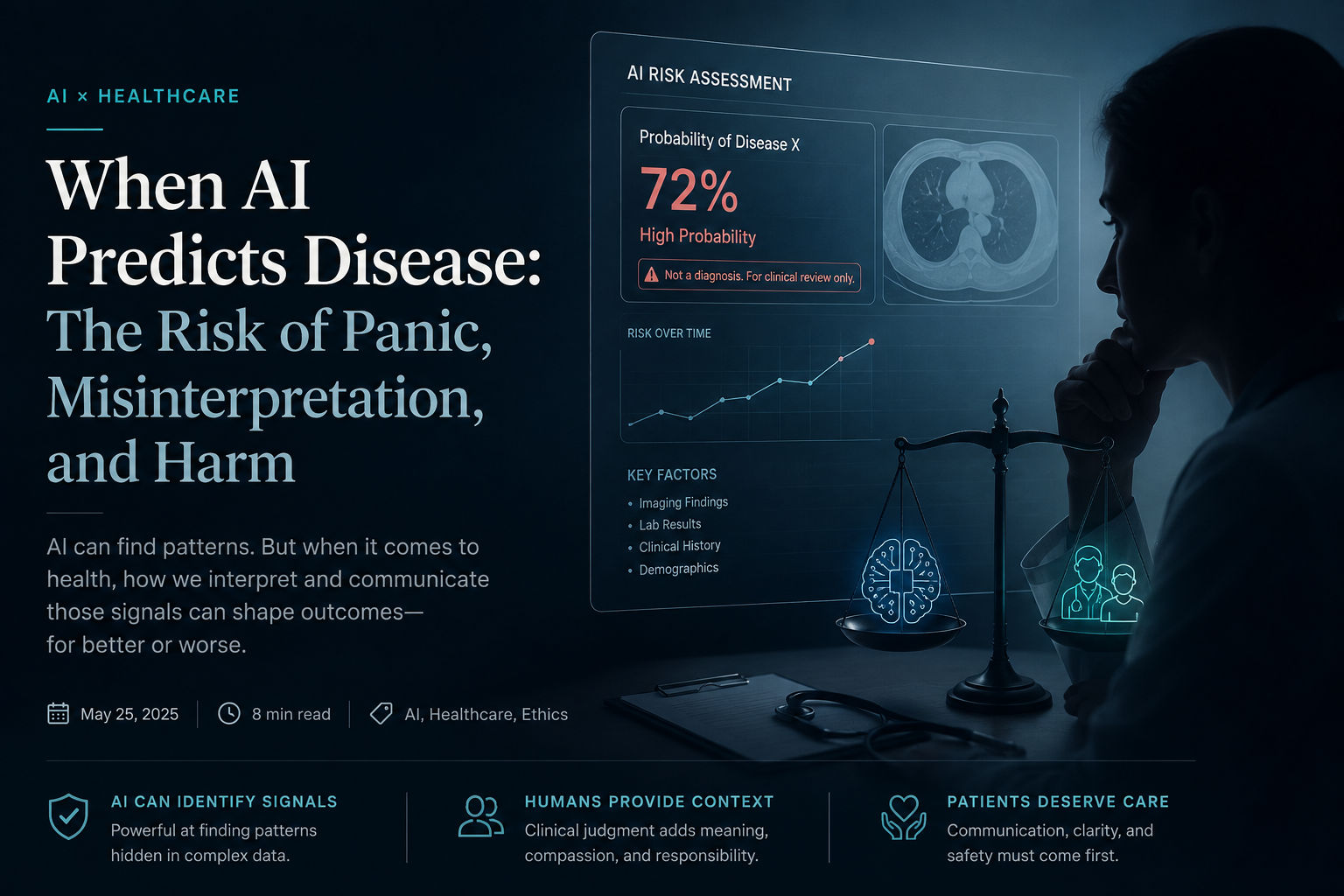
When AI Predicts Disease: The Risk of Panic, Misinterpretation, and Harm
Medical AI can identify patterns and estimate health risks, but communicating uncertain predictions to patients is a fundamentally different problem from making the prediction itself.
A Probability Is Not a Diagnosis
Artificial intelligence is increasingly being used to analyze medical images, laboratory results, clinical records, biological networks, and behavioral data. These systems can identify patterns that may be difficult to detect manually and can support earlier clinical assessment.
However, an AI prediction is not the same thing as a medical diagnosis. Consider a system that reports:
"The estimated probability of disease X is 72%."
From a machine learning perspective, this may represent a statistical risk estimate derived from the model and its input data. A patient may interpret it very differently:
"I have disease X."
That difference matters. Patients may not have the statistical background necessary to distinguish probability, uncertainty, sensitivity, specificity, calibration, or predictive value. Presenting a model output without appropriate context can therefore create unnecessary anxiety.
Doctors Interpret More Than a Test Result
A physician does not simply receive a probability score and communicate the most alarming interpretation to a patient. Clinical decision making considers symptoms, medical history, family context, additional investigations, uncertainty, and the patient's overall condition.
Communication also matters. A doctor can explain what is known, what remains uncertain, what additional tests may be required, and what the result does not mean.
AI can estimate risk. Clinical professionals interpret that risk within the context of an individual patient.
When AI Detects Behavioral or Psychological Risk
The challenge becomes substantially more sensitive when AI systems analyze information related to mental health, behavior, or potential self-harm.
Imagine a system analyzing clinical records, speech, behavioral patterns, or other data and identifying an elevated statistical risk associated with suicidal behavior.
Such a signal could potentially help a trained clinical team recognize that additional assessment may be necessary. But presenting the raw prediction directly to a patient creates a different set of risks.
A Risk Signal Is Not a Prediction of the Future
An elevated model score does not mean that a person will attempt suicide, nor does it establish intent. It is a statistical signal that requires appropriate clinical interpretation and assessment.
A patient could misunderstand the output, become frightened, feel stigmatized, or believe that an algorithm has made a definitive judgment about their mental state.
The Human-in-the-Loop Is Part of the System
For high-risk medical applications, human oversight should be designed into the system architecture rather than added after deployment.
The AI performs computational analysis. The clinical team determines what the signal means in context. The patient receives information that has been interpreted with appropriate uncertainty and clinical judgment.
Explainability Alone Is Not Enough
Explainable AI can help clinicians understand why a model generated a particular prediction. However, explaining a model does not automatically make the prediction safe to communicate directly to a patient.
Model Explainability
Why did the model produce this prediction?
Clinical Explainability
What does the prediction mean for this patient?
Communication Explainability
How should the result be communicated safely and accurately?
The third layer is particularly important because technically correct information can still cause harm when presented without sufficient context.
Designing Safer Medical AI
A responsible medical AI system should not be evaluated only by predictive accuracy. Its interaction with clinicians and patients also needs to be considered.
- Clearly communicate uncertainty.
- Never present probabilistic outputs as confirmed diagnoses.
- Provide appropriate clinical context.
- Require human review for high-risk decisions.
- Protect sensitive psychological and behavioral information.
- Evaluate potential harms caused by incorrect interpretation.
- Design patient-facing communication separately from raw model outputs.
The Question We Should Ask
As AI becomes increasingly capable of analyzing human health, the important question is no longer simply:
"Can AI detect this?"
Beyond Model Accuracy
Healthcare AI should be designed around the complete patient journey rather than the accuracy of an isolated model.
A model can have excellent predictive performance and still create harm if its outputs are misunderstood, poorly communicated, or used without adequate human oversight.
The future of medical AI therefore requires more than better models. It requires better uncertainty communication, stronger clinical safeguards, responsible human-AI interaction, and systems designed around patient safety.
AI can identify a signal. A clinician must determine what that signal means. When the consequences are deeply personal, how the information is communicated can be just as important as the prediction itself.