Human-in-the-Loop Reinforcement Learning: When Humans Guide How AI Learns
Reinforcement learning can optimize an objective, but defining the right objective is often the hardest part. Human-in-the-loop reinforcement learning introduces human feedback into the learning process, allowing people to guide, correct, and evaluate AI behavior when rewards are difficult to specify.
By Md. Mehedi Hasan
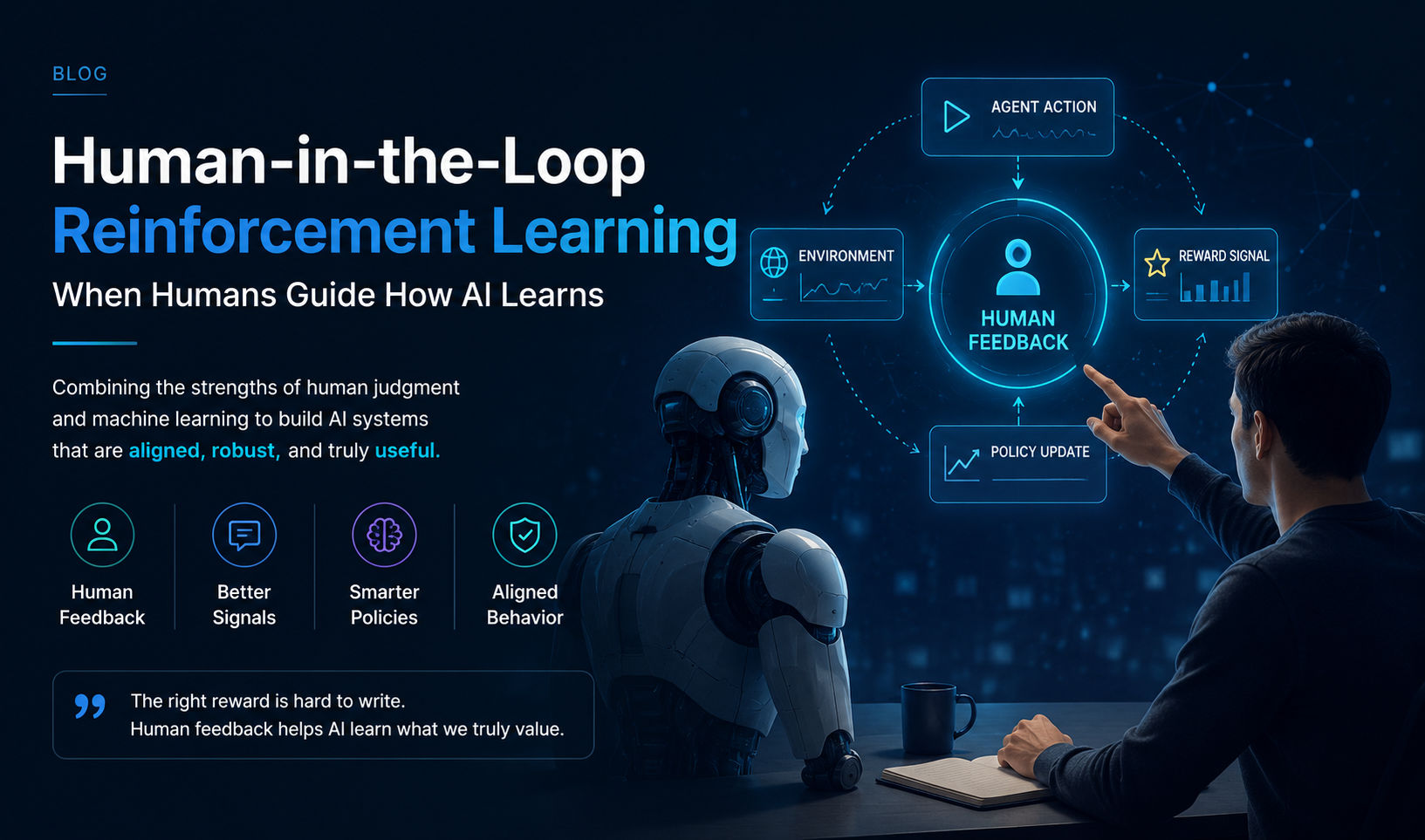
Reinforcement learning (RL) is built around a simple idea: an agent interacts with an environment, receives feedback, and gradually learns which actions lead to better outcomes.
The difficult part is often not the learning algorithm itself. It is deciding what "better" actually means.
In many real-world problems, the desired behavior is too complex to express as a simple numerical reward. A reward function may capture what we can measure while missing what humans actually care about.
This is where Human-in-the-Loop Reinforcement Learning (HITL RL) becomes useful. Instead of treating the reward function as completely fixed, humans can participate in the learning process by providing demonstrations, preferences, corrections, critiques, or other forms of feedback.
Why Reinforcement Learning Needs Human Guidance
A conventional RL problem can be represented as a Markov Decision Process:
(S, A, P, R, γ)
where S represents states, A actions,
P the transition dynamics, R the reward function,
and γ the discount factor.
The policy learns to maximize an expected cumulative reward:
J(π) = E[Σ γt rt]
Mathematically, this is elegant. Practically, defining
rt can be extremely difficult.
Consider an autonomous system where we want an agent to behave safely, efficiently, predictably, and according to human preferences. A reward function that only rewards task completion may encourage behavior that technically achieves the objective while violating the intended constraints.
This is commonly described as the reward specification problem: the system optimizes the objective we provide, not necessarily the objective we intended.
What Human-in-the-Loop RL Changes
HITL RL introduces human judgment into the learning loop. The human does not necessarily need to control every action of the agent. Instead, human feedback can influence how the agent evaluates and improves its behavior.
Human → provides feedback → Agent → takes action → Environment → produces behavior → Human → evaluates behavior → feedback improves learning
The important idea is that learning becomes iterative. The agent acts, humans evaluate meaningful behavior, the learning signal is updated, and the agent improves its policy.
Different Ways Humans Can Provide Feedback
Reward Shaping
Humans can provide additional reward signals that help the agent distinguish between desirable and undesirable behavior.
Preference Feedback
Instead of assigning an exact numerical reward, a human can compare two behaviors and indicate which one is preferable.
Behavior A + Behavior B → human comparison → preferred behavior → learning signal
This is useful when humans can reliably say which outcome is better but cannot easily quantify exactly how much better it is.
Demonstrations
Humans can demonstrate how a task should be performed. These demonstrations can provide an initial behavioral signal before reinforcement learning further optimizes the policy.
Corrections
A human can intervene when the agent begins moving toward an undesirable behavior. The correction becomes additional information about the desired policy.
Critiques
Human feedback can also describe why a behavior is undesirable. Rather than simply saying that an action is wrong, a critique can provide richer information about the failure.
From Human Feedback to a Learned Reward
One important approach is to use human preferences to learn a reward model.
Suppose a human compares two trajectories, τ1 and
τ2, and prefers the first.
Trajectories → human preference → preference dataset → reward model → estimated reward → policy optimization
A parameterized reward model rφ can then learn to
approximate the preferences expressed by humans.
The reinforcement learning system can optimize this learned signal instead of relying entirely on a manually engineered reward function.
This creates an important separation between two problems:
- Humans express which behaviors they prefer.
- The learning system discovers how to reproduce those preferences.
HITL RL Is Broader Than RLHF
Human-in-the-loop reinforcement learning is a broad concept. Reinforcement Learning from Human Feedback (RLHF) is one important family of approaches within that broader idea.
HITL RL can include demonstrations, direct interventions, corrections, preference comparisons, reward shaping, critiques, and other forms of human supervision.
Human-in-the-Loop RL → demonstrations → corrections → preferences → critiques → reward shaping → learned reward signals
The distinction matters because human involvement does not have to mean training a reward model from pairwise preferences. The appropriate feedback mechanism depends on the task and the type of human knowledge available.
The Complete Learning Cycle
A practical HITL reinforcement learning workflow can be understood as a continuous research and engineering cycle:
Define objective → train initial policy → collect behavior → obtain human feedback → construct learning signal → update reward or policy → evaluate behavior → human review → identify failures → repeat
This flow changes the role of human supervision. Instead of attempting to manually specify every desirable behavior in advance, humans provide information where the learning system is uncertain, incorrect, or poorly aligned with the intended objective.
Why This Can Be More Practical
Human feedback can be particularly valuable when objectives contain qualitative properties that are difficult to encode directly.
- Complex preferences: humans can evaluate behavior that is difficult to formalize.
- Reduced reward engineering: preference data can replace some manually designed reward logic.
- Behavioral alignment: the learned objective can reflect observed human judgments.
- Failure discovery: humans can identify undesirable behaviors that automated metrics miss.
- Iterative improvement: feedback can focus on the weaknesses revealed during evaluation.
The Human Is Also a Source of Noise
Human feedback does not automatically solve the alignment problem. It introduces another source of uncertainty.
Agent behavior → human judgment → inconsistent feedback → noisy preference data → imperfect reward model → imperfect policy
Humans may disagree with one another. Individual judgments can also change depending on context, fatigue, expertise, available information, or how a behavior is presented.
This means that feedback quality becomes an important part of the learning system.
The Main Challenges
Feedback Cost
Human evaluation requires time and expertise. Large-scale reinforcement learning can generate enormous amounts of behavior, making continuous manual supervision impractical.
Human Inconsistency
Different evaluators may make different judgments about the same behavior. Even the same evaluator may change their judgment across contexts.
Bias
A learned reward model can reproduce systematic biases present in the feedback data.
Reward Hacking
An agent can discover strategies that maximize the learned reward without producing the behavior humans actually intended.
Scalability
The central engineering challenge is deciding where human feedback provides the highest value rather than asking humans to evaluate everything.
A Better Research Strategy
A strong HITL system should treat human feedback as an information resource, not simply as another training label.
Automated evaluation → detect uncertainty or failure → prioritize informative cases → human evaluation → update learning signal → retrain → automated evaluation
This creates an opportunity for active learning and human feedback prioritization. Instead of spending human effort uniformly, the system can focus evaluation on ambiguous, high-risk, or high-impact behaviors.
Potential Applications
Human-in-the-loop reinforcement learning is relevant to domains where objectives involve both measurable outcomes and human judgment.
- Robotics and physical task learning
- Autonomous systems
- Recommendation and personalization
- Interactive AI assistants
- Human-AI decision support
- Healthcare research and decision-support systems
In healthcare-oriented research, for example, human expertise can be used to evaluate whether model behavior is clinically meaningful rather than relying only on an optimization metric. Such systems require particularly careful validation because high reward does not automatically imply safe or clinically appropriate behavior.
What Changes When Humans Enter the Loop?
Traditional reinforcement learning asks:
What policy maximizes the reward function?
Human-in-the-loop reinforcement learning asks a more fundamental question:
Does the learning signal actually represent the behavior we want?
That shift is important. The central challenge becomes not simply improving optimization, but improving the connection between human intent, measurable feedback, learned objectives, and agent behavior.
Conclusion
Human-in-the-loop reinforcement learning does not replace reinforcement learning. It changes how the learning objective can be constructed, evaluated, and refined.
Human intent → feedback → learning signal → agent behavior → evaluation → human review → improved learning
The most useful perspective is therefore not that humans are permanently controlling the agent. Instead, humans provide the knowledge required to guide optimization toward objectives that are difficult to specify with reward functions alone.
As AI systems move into increasingly complex environments, the ability to combine automated learning with structured human judgment may become an important part of building systems that are not only capable, but also interpretable, robust, and aligned with their intended use.